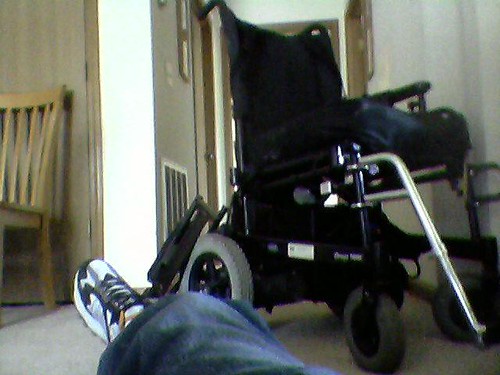
That Only Took Three Months
I finally got my wheel repaired and returned to me last week.
Today is August 15th, 2007 and today authorization was finally given for the repairs to be made to my long-defunct wheelchair wheel. Henceforth, my wheel is officially now in the process of being fixed. It only took nine weeks to get to this point. Why does it take nine weeks to get a piece of paper faxed to a doctor, signed by the doctor, and faxed back to where it originated? As an outsider to the process, I can only make inferences based on observation and information collected post-fact, but my conclusion is that it takes a delicate combination of ineptitude, negligence, irrational bureaucratic protocol, and a lack of accountability on the part of those involved. Here’s a recap:
On June 12th, I took my malfunctioning wheel to Michigan Wheelchair Seating for repairs. Unable to repair the wheel in-house, I was informed by the repair technician that the wheel needed to be sent back to the manufacturer for repairs. The wheel would be sent out the next day and I should have it back within three weeks. I was loaned a power wheelchair for the time being. The information given to me by the technician seemed plausible and operating under the assumption that it was true I did nothing more about my wheel and went about my business for the next two weeks. Yes, it is true that the repairs would be done by the wheel manufacturer, but the timetable given to me by the technician was completely erroneous. In addition he left out a major detail that no work on the wheel would be started until the necessity of the repairs was confirmed by my doctor and authorization of payment for the repairs was confirmed by my insurance.
June 25th I called Wheelchair Seating to find out if there was any information on when I would get my wheel back. The receptionist seemed confused about what I was asking and wanted to know who I spoke to about my wheel repair. I gave her the name of the technician who took my wheel in for repairs and asked to have him call me back. He never did.
On July 2nd I placed another call to Wheelchair Seating again inquiring about the repair of my wheel and this time spent the majority of a fifteen minute phone call on hold as the receptionist looked up my file. I was told that the paperwork was being processed and that my information was in the system. Still operating under the assumption that the manufacturer was in possession of my wheel and performing repairs again I asked when I would be getting the wheel back. I was told by the receptionist that she didn’t know when it would be finished. I asked if she could have someone call the manufacturer and find out when they would be returning the wheel. This also did not happen.
After the Fourth of July holiday week in which I knew nothing would be done on my wheel, I called Wheelchair Seating again on July 10th. At this point in time it was approaching a month since I had dropped off my wheel for repairs and now I was expecting to have my wheel returned to me. This time I was passed on to another person’s voice mail account to which I left a message explaining what had happened up until that point and that I was expecting to hear when I would be getting my wheel back. The person never returned my call.
I called back again the following week and was shuffled to the same voice mail account as during my previous call. Again, I explained the situation (as I knew it to be true) and asked for an update on the progress of my wheel repair. For a second time the person responsible for that voice mail account did not return my call.
The week of July 24th I placed yet another call to Wheelchair Seating, but instead of being shuttled off to another anonymous voice mail account I asked to speak to a personal contact I had there from my time in Michigan’s out-patient physical therapy program. My former physical therapist had taken a position at Wheelchair Seating performing wheelchair fitting evaluations and although she was not responsible for any of the repairs being done to my wheel, I called her to see if she could find out what was happening. Par for the course, I did not speak with her directly, but instead had to leave her a voice mail explaining that the three-week timeframe I was given had stretched to six and I was still in the dark about the status of my wheel repair. Two hours later I checked the messages on my phone and I had a message from the person at Wheelchair Seating responsible for confirming the authorizations for all repairs. The information she had for me was not good.
When I called the authorizations person back that afternoon, fuming over the impending news that nothing had happened with my wheel repair yet—which it had not—it was explained to me that she was still waiting for my doctor to sign the referral confirming the necessity of the repairs and equipment I needed. Wondering why they would need my doctor to sign off the work order, I told her this was a repair and not a new equipment order. She explained that the repairs I needed were not covered under warranty and that anytime insurance needs to be billed the doctor must sign off on the repairs. Why wasn’t I notified of this and when did the doctor get the referral that needed to be signed? After a long pause and much paper shuffling she informed me the referral was faxed to the doctor’s office on June 19th. There really wasn’t a date she could give me that would justify any of this delay, but when she came back with the 19th I immediately realized this was a full week after I had brought the wheel to Wheelchair Seating. A week’s delay in getting the necessary paperwork together is ridiculous; especially in conjunction with the new information I was just given concerning their protocol of needing a doctor’s referral to bill my insurance. In my mind it seems once the problem is diagnosed, sending the referral to the doctor should be the first thing that gets done and there is no reason it should be done any more than a day later. In fact, the buildings that house Wheelchair Seating and my doctor’s office are literally within a mile of one another. I could physically walk the referral request to the doctor’s office from Wheelchair Seating in less time and it takes two people to help me walk.
So there was one week’s delay accounted for, but what the hell was going on in the intervening five weeks? The authorizations person at Wheelchair Seating couldn’t answer that question, but she was pretty sure my doctor was on vacation for part of that time. I told her someone over there should have called his office to find out what the hold up was and someone should have called me to let me know they were waiting on my doctor to sign the referral. None of this happened. For five weeks my wheel sat in their shop and collected dust. The technician who took it from me probably walked by it every day and not once did he think to himself, Man, that sure has been sitting here a long time. I wonder if I should find out what is holding up this repair? Or, if he did have those thoughts he didn’t get very far in acting on those notions. Not one single person at Wheelchair Seating took any initiative to find out what was going on with the referral, nor did they take any initiative in contacting me to fill me in on what was going on, or more appropriately, not going on. Had I not called and gotten someone completely uninvolved with this repair order poking around in my favor, I would probably still be none-the-wiser. She apologized for the communications breakdown and asked that I call my doctor’s office and see if I could get them moving faster. Her rationale was sound in asking me to do that, but it was also a bullshit way—whether intentional or not—of absolving herself of some of the responsibility for resolving this fiasco. But I made the call, because I also knew it was going to be up to me to get everyone involved on the same page from now on. Before I concluded that call, she asked me that once I talked to my doctor to call her back in a week to see where everything was at. Right, a week; because what’s one more week when six have already been wasted? I wanted to punch her.
When I called my doctor’s office and finally got a hold of his administrative assistant, I was informed that yes, it was true he was indeed on vacation and wouldn’t be back in the office until August 9th, which was the following week. When I asked whether or not the referral script had come through like I had been told it had, after much paper shuffling I was told that they did actually have the script. Why my doctor did not sign the referral before he left on vacation—you know, tie up loose ends like everyone else in the world does before going on vacation (he had ample time: at least three weeks by my calculations)—remains a complete mystery. I have my suspicions and those start with his assistant and her organization skills, but no way to prove them. I asked if anyone else, one of the other doctors, maybe his Physician’s Assistant, would sign off on the referral. It was not for a new equipment order, just a repair; it seemed logical to me that whoever was covering for my doctor would do that, especially considering the circumstances. The administrative assistant told me she would ask the Physician’s Assistant and get back to me that afternoon. She didn’t. I called the next morning to see if my request had been considered, she said she would ask the Physician’s Assistant, if I could hold. I waited on hold and after a few minutes she came back on the line and explained that, for whatever reason, the Physician’s Assistant didn’t feel comfortable doing that. So, I was again told the doctor would get to it when he got back in the office on Thursday the 9th. Fine, I said and hung up. In my mind it was, Fine. Fuck you guys, this whole thing is preposterous!
In the interim of all this wheelchair fiasco, I have developed a pressure sore on the back of my thigh. Pressure sores aren’t good and I’m pretty sure it came about from one of the activities I do at physical therapy. I’d like to be able to attribute it to not having my wheelchair in working order, just so as I can focus all my problems and blame around one central issue and group of people. Realistically, the sore and the wheelchair are unrelated, but coincidentally the state of the sore put me in my doctor’s office the day after he was supposed to have been back from vacation. My morning appointment time put me in the examination room with the Physician’s Assistant and not my doctor and led to this conversation:
“How are you Dan? It’s been a while since I’ve seen you.”
“Well, the reason I’m here is because of this sore, but I’m also still waiting on the doctor to sign the referral for my wheelchair repair.”
“Oh, that’s right. Yeah, with Medicare cases, as a Resident, I’m not allowed to sign off on the doctor’s refer—“
I cut her off, “I’m not on Medicare. I have private health insurance.”
“Oh. I can probably sign it then. Let me go check,” and she hurried out of the exam room. A new reason for me to want to kill; she made her decision to not sign off on the referral based on misinformation, easily verifiable misinformation. When she re-entered the exam room, she said, “The doctor already has the referral. He’ll sign it today.”
That was last Friday. I know from discussions with the authorizations person at Wheelchair Seating on Tuesday of this week that the referral actually came through on Monday, but really, what is another day at this point anyway?
What pisses me off about this whole ordeal is that the people I’m dealing with work on a daily basis with clients and in an industry of providing necessary services. Wheelchairs by their nature, with very few exceptions, are not luxury items. It’s not as if I took Grandpa’s old pocket watch down to the jeweler and asked the guy to clean and refurbish it “whenever you get the chance.” I’m not cruising around in this wheelchair because it’s a good way to pick up chicks; I need this wheel repaired and I needed it repaired six weeks ago! If there are going to be delays in the repair beyond what Wheelchair Seating can control, I can understand that, but this whole fiasco was caused by a breakdown within their own well-worn system and the fact that nobody lifted a finger in my favor speaks volumes about the quality of service they care to provide.
So, once again I have learned a lesson the hard way. And what I have learned is that these people can’t be expected to provide quality service even though that is the job they have chosen to do. The question is will they learn anything when I no longer take my business to them?
My wheelchair crapped out on me on Tuesday. Wednesday was worse.
I had been noticing over the course of the last couple of months that I had one wheel that appeared to be a bit out of alignment, but it was only noticeable if I was at my therapy clinic where I could see the chair head-on in front of a full-length mirror. Some wheelchairs have a camber angle built into them, the purpose of which I believe is improved stability and steering, but don’t quote me on that. Regardless, my chair doesn’t have that and so a wheel out of alignment is something that should be checked out. My wheelchair has a collapsible frame, and I went so far as to check to make sure that the frame of the chair was properly extended and the slight tilt of the wheel wasn’t being caused by some small, correctable adjustment to the frame. Then when there wasn’t anything that could be done to the frame to fix the tilt, I sort of let it be and forgot about it. Every once in a while I’d catch my reflection in the clinic mirror and notice the tilt to the wheel, but it didn’t appear to be getting any worse, so I didn’t do anything about it. Worse case scenario was that maybe the axel bracket was coming lose in some way and needed to be tightened. Something that could be gotten done down the road or at anytime in between when I thought about it..
I already have plenty of complaints about the design of my chair and its wheels. First of all, any of the decisions I made about what kind of chair I wanted, were made at a time when I was still trying to get healthy enough to leave the University of Michigan hospital for the first time after my accident. At that time, my strength and functional abilities were drastically different than they are now and so the chair I have now was ordered based on what I was able to do over three years ago. One currently needless feature is that I ordered the aforementioned collapsible frame, because at the time I was without my own transportation and so any time I wanted to go somewhere, I needed a chair that could be folded up and stowed in the trunk of friends’ or family members’ vehicles. Even though it affords the owner some flexibility when traveling with other people, folding frames are heavier than rigid wheelchair frames and ever since I bought my van I never fold it down now anyway. I have a bracket bolted to the bottom of my chair that holds a pin, which in turn slides into a lock mounted to the floor of my van to keep my chair secured while driving. The bracket prevents the frame from being collapsible. A second drawback to the bracket is it also adds a significant amount of weight to the chair. Another change I would like make to the chair would be to get rid of the inflatable tires. I’m constantly adding air to my tires to maintain a hard, fast ride. Under-inflated tires add resistance when trying to push around and I have also blown out the inner tubes in either tire at different times when trying to have someone help me inflate the tires with my shoddy, tire pump. The next set of tires I buy will have solid, tubeless inserts so I never need to worry about low tire pressure. In addition to the tires, I don’t like the design of the leg supports and foot plates at the front of my chair. Currently, the leg supports are designed to swing open and the foot plates pivot up and these features were selected at the time to ease my transfers in and out of the chair. I learned, however, that when I perform my transfers it is much easier to balance and complete the transfer if I leave my feet on the foot plates; therefore the flexibility of my chair’s current configuration is kind of pointless. However, those are all minor gripes and only interfere with my mobility on an occasion. Without a doubt, the aspect of my chair that gives me the most routine grief are the specialized wheels I’m using.
My wheels have a battery powered electric motor in them that, even though I propel my chair manually, allows me to do so without burning out my shoulders and arms in the everyday process of getting around. My power-assist wheels have enough propulsion in them to make it possible for me to get up-and-down most inclines without needing help. The breaking-resistance function on a decline keeps me from having to worry about my chair getting away from me and sending me careening downhill out of control if I lose my grip. I’m also able to roll through grass if need be, although I found out over Memorial Day that soft, sandy ground is debilitating even with these wheels. When I have to traverse long distances, I can set the wheels to a low gear ratio that makes it quite easy to move my chair. So it is those features that make them the most viable option for someone like me who wants a manual chair, but doesn’t have the strength or stamina to go to a full manual set-up. Yet the wheels, despite their functionality, are not without their flaws.
Despite taking great care to get a full charge every night, depending on how much I wheel around during the day, I often run the danger of running the batteries all the way down. It's not uncommon for me, upon arriving home after a morning and afternoon of consistent wheeling, to need to recharge my wheelchair batteries for an hour before heading back out for the evening. It's a contingency plan I learned after having one or both wheels die on me unexpectedly when out in public. The problem isn't so much that the batteries have died, but that when the batteries are dead, I'm then pushing an additional 50 pounds of dead weight, which is how much the wheels weigh by themselves. On top of the weight of the chair and my own body weight, this additional resistance prevents me from pushing up any incline or even pushing a moderate distance without significant exhaustion-inducing effort. In relation to the wheels needing to be charged every night, if I feel like going somewhere for more than a day I have to make sure and pack the battery charger. Over the course of three years, I’ve also had problems with the power cord to the battery charger and both charging leads developing shorts in them from general wear and tear. This in turn, can lead to an insignificant battery charge, my wheelchair batteries running low, and so on and so forth. The pattern repeats itself. Ultimately I’d like to be able to get into regular manual chair and leave all these issues of dealing with batteries and chargers and excessively heavy wheels behind me, but my arm strength, limited endurance, and lack of grip just make that proposition unrealistic in the here and now.
At the other end of the spectrum I could always get a full-sized power chair. There are plenty of unique power chairs with amazing features to choose from: chairs that recline, chairs that stand the rider, chairs that can go off-road, and even chairs that can climb stairs. The first problem I have with all these types of power wheelchairs is their sheer bulk. I constantly encounter restaurants, stores, and bars were I have hard time navigating up under tables, around cluttered floorplans, through crowds, and into restrooms in my wheelchair. Most power chairs sit up higher and have a larger footprint that would exacerbate getting around in these types of spaces. You can also forget about going into anyone's house that doesn't have a ramp, or traveling in someone else's car with a power chair. To my knowledge, there isn’t a power chair made that weighs less or that has a smaller profile than my current chair that would make any of those situations easier to navigate. Then aside from the logistical limitations of a power wheelchair, on a personal level, the other main reason why I don't want a power chair is how I feel about my self when I use one. Going out into the public-at-large in a wheelchair is a spectacle to begin with, but in a power wheelchair I feel like I stick out even more. Of course, high-level quads, people with MS, stroke survivors, or people with a TBI who have to use power chairs all of the time, would trade places with me in a heartbeat. The other added benefit of my current wheelchair configuration is that pushing my chair does provide me an opportunity to get a fair amount of cardiovascular exercise. So from the standpoint of my own self-esteem, even though my power-assist manual wheelchair gives me all sorts of shit, I prefer it over the power wheelchair because it makes me feel more vigorous.
On Monday the problem with my wheel worsened to the point where I thought it was in danger of falling off, so I anticipated making an appointment Tuesday morning to take my wheelchair in to get it fixed. I own a set of spare, manual wheels and I had my aide swap out the bad power-assist wheel for one of the manual wheels. I quickly recognized how difficult it is to push a manual wheel on my heavy-ass wheelchair across the carpeting in my apartment. Exiting down the ramp of my van without the assisted breaking of two fully functioning power-assist wheels added a new degree of difficulty, as the dead-weight momentum of the manual wheel almost sent me off the side edge of the ramp, and further drove home the point of how much I need my power-assist wheels. Unfortunately, I was informed at the wheelchair seating service it was probably going to be upwards of three weeks before I got my wheel back in working order. I asked if they had any spare power-assist wheels that I could borrow for the time being. They did not, but they could put me in a loaner power chair. I told them I’d think about the offer. Tuesday night, as I lay awake trying to massage the rock-hard knot of tightly cramped and fatigued muscle fibers at the base of my neck, I decided that if I was going to be without a properly functioning wheel for any significant amount of time, I was going to need a loaner wheelchair.
On Wednesday morning I drove back over to the wheelchair seating service to pick up the power chair they had set aside for me and I dropped off my defunct power-assist wheel to be shipped back to the manufacturer. The wheelchair tech who I talked to about the problem with my wheel reassured me that sending the wheel back to the company probably wouldn’t take as long as the three weeks he originally quoted to me if he put in an order for the parts to fix it himself.
“How long then?”
“Oh, definitely less than three weeks.”
That’s definitive. Fan-F’ing-Tastic.
The power wheelchair the tech set me up with is a complete P.O.S.: the low-profile seat cushion that came with it is uncomfortable; the back rest is too high, altering my posture and thus throws off my sitting balance; the foot plates are flimsy; the speed control adjustment is missing its knob and stuck on one setting; it lacks any sort of battery level indicator lights; and there isn’t a way to actually secure it to the floor of my van while I drive, so I’m banking my safety on the chair’s weight and the fact that its wheels lock up when the power is turned off. Before I left I had to send the guy back inside to retrieve for me the battery charger that fit this particular chair. After I got myself secure in the driving compartment of my van the wheelchair tech loaded my original wheelchair in my van behind me and he locked the brakes to keep my other chair from rolling around behind me as I drove. Of course this meant that I wouldn’t be able to get out of my van when I got back home, so I called my buddy Jak to meet me at my place to help me exit my van. When we got everything unloaded and back to my apartment, I had Jak help me clean up some of the grime off of the loaner power chair. We also switched out the crappy seat cushion that came with the power chair with my Roho air cell seat cushion. The Roho cushion is nearly twice as thick as the one that came with the power chair and helped to temporarily alleviate some of the posture problems I was experiencing. We then hung out for about a half an hour and then Jak got ready to leave.
I followed him down the hallway of my apartment and stopped at the opening of the hallway that makes up the living room-dining area. Jak grabbed his keys and flip-flops and headed out the door. In that moment I pushed forward on the control stick of the power chair and nothing happened. I looked down at the single, green power indicator light next to the control stick; it went blank, blinked red, and then went blank again. I pushed up on the control stick a second time, and again nothing happened; I watched the same sequence of blinks on the power indicator light. In that instant my front door closed behind Jak. I flipped off the power for a second and flipped it back on, hit the control stick again, the chair lurched forward an inch and then nothing.
“Jak! Wait!” I yelled as I quickly glanced down to my lap for my cell phone. It wasn’t in my lap. “Jak!” I cast a darting glance to the end table, eight feet away against the half-wall that separates my kitchen and dinning area. There amidst the clutter of things routinely I cart to and from my van—spare change, keys, iPod, sunglasses—was my phone, utterly out of reach. I looked out my front window to see Jak pulling away in his Jeep. Across the living room the digital clock on the cable box sitting on top of my TV read 12:38.
The next five minutes or so I spent trying to decide what in the hell I was going to do. Without battery power a power wheelchair is a hundred and fifty pounds of “I’m screwed.” I briefly thought about yelling until one of my neighbors heard me, but that would never work. I hadn’t seen the car of the woman who lives above me for days and it wasn’t out in the parking lot now. I was too far from any adjoining walls to try bang on and draw the attention of the neighbors that lived on the backside of the building, and who knew if they were even home.